
One of the first issues new traders come across is the multitude of assets to choose from, making it difficult to know where to start. Beginners should look at the details of the main asset classes to see which one is most suitable for their style.
An asset class is simply a category into which different financial instruments are divided. Stocks, Forex, and indices are among the most common choices for newcomers, since most people are already familiar with these assets.
Asset Classes Explained: Meaning and Definition
The simplest definition of an asset class is a grouping of financial instruments that have similar characteristics. Defining these groups is the basis of investing, since it tells traders how they can invest in unrelated assets that don’t move together, giving a degree of diversification.
Each asset class has investments that are similar to those in the same group but different from those in other classes. They should only fit into one of the main classes at any time. They’re also expected to react in different ways to economic news and events than assets in other classes.
Types of Asset Classes and Examples
Before investing in any asset, traders should be aware of its unique characteristics.
Stocks
Also known as equities, these assets let investors obtain a percentage of the ownership of a public or private company. They’re used for capital appreciation and to earn dividends.
While this is a single asset class, the risk and volatility levels vary greatly among different shares.
- Blue-chips (Shell, HSBC, Microsoft, etc.) tend to be relatively steady due to their large market capitalisation.
- Lower-priced shares or those issued by newer companies may be more volatile.
Forex
Traders might see this listed as part of the cash and cash equivalents (CCE) class. However, the Forex market has unique characteristics and can also be listed alone. It is the buying and selling of different currency pairs.
- Major pairs include the USD and another large currency (like EUR/USD)
- Minor pairs cover two important currencies without the USD (EUR/GBP).
- Exotic pairs include one major currency and another from an emerging economy (USD/ZAR, EUR/TRY).
Fixed Income Bonds
These are loans made by investors to a borrower, usually a government or corporation. They provide the investor with regular interest payments in the form of coupons, together with the return of the capital at the agreed time.
- Government-issued bonds like US Treasury Bonds, UK Gilts, and German Bunds are among those considered the safest.
- Investment-grade bonds are issued by blue-chip companies with high credit ratings.
- High-yield bonds are also known as junk bonds. They are issued by companies that have lower credit ratings and offer a higher interest rate to compensate for the perceived higher risk.
Commodities
Energy, metals, and agricultural products can be bought and sold online. They are often seen as a safe haven or form of hedge against currency devaluation.
- Gold and silver
- Copper
- Coffee, wheat
- Crude oil and natural gas
Indices
This is a financial product that includes a selection of related assets, often stocks from the same exchange.
- S&P 500 gives a snapshot of the American economy through the prices of the top 500 companies.
- Nasdaq 100 is a non-financial US index with a strong focus on technology and retail.
- FTSE 100 provides a look at the biggest companies operating in the British market.
These different asset classes all move separately in the market. So, the next step is to work out the key differences that let you decide which is best for you.
Stocks vs Forex vs Indices: Key Differences for Beginners
Each of these asset classes can be assessed using criteria such as volatility, trading hours, and complexity. This allows traders to quickly understand the choices more easily.
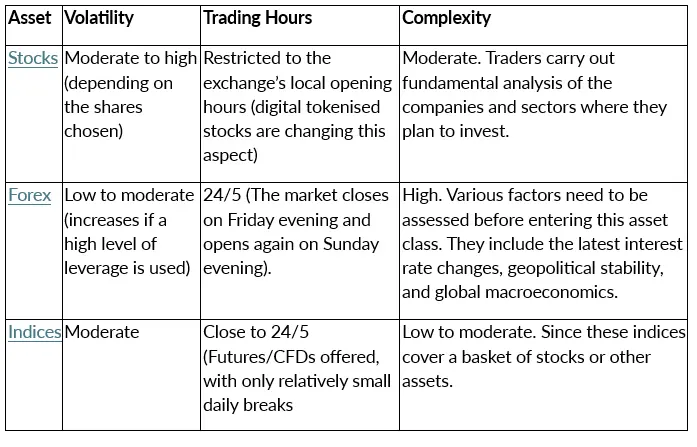
Multi-Asset Class Strategy and Diversification Basics
Some investors focus on a single asset class. However, multi-asset class investing is another approach worth considering.
This is where investors include alternative asset classes as a way of diversifying their portfolio. Each category is affected by different factors and events. So, diversifying is a way of managing risk.
Many traders look for inverse correlation, which is the situation when they expect one asset to rise if another falls. For example, if interest rates rise, bonds and Forex trades may be negatively affected. Yet, investors who also hold stock and commodities may expect them to increase in value at the same time.
Asset Classes FAQs for Beginners
What is the Safest Asset Class?
Treasury bills and bonds are generally regarded as being the safest types of assets. This is due to their low volatility and the fact that they’re backed by governments or large corporations.
How Many Asset Classes Do I Need to Get the Right Level of Diversification?
There isn’t a magic number. Some analysts mention three of five uncorrelated asset classes as being ideal. As a starting point, a 60/40 split between stocks and bonds can be a solid choice.
Why Do Interest Rates Affect All the Asset Classes?
A look at the list of asset classes reveals that interest rate changes affect them, but in different ways. This is because interest rates tell us the current price of borrowing money. This means that the fluctuations affect company borrowing, the currency's value, and the cost of living at the same time.
Is an Asset Class and an Index the Same Thing?
No, an asset class is a category that brings together all the financial instruments with the same characteristics. An index is a carefully selected basket of assets that are generally from the same class, but it doesn’t include everything in that class.
The information provided does not constitute investment research. The material has not been prepared in accordance with the legal requirements designed to promote the independence of investment research and as such is to be considered to be a marketing communication.
All information has been prepared by ActivTrades (“AT”). The information does not contain a record of AT’s prices, or an offer of or solicitation for a transaction in any financial instrument. No representation or warranty is given as to the accuracy or completeness of this information.
Any material provided does not have regard to the specific investment objective and financial situation of any person who may receive it. Past performance is not a reliable indicator of future performance. AT provides an execution-only service. Consequently, any person acting on the information provided does so at their own risk. Forecasts are not guarantees. Rates may change. Political risk is unpredictable. Central bank actions may vary. Platforms’ tools do not guarantee success.