
Short squeezes are among the most exciting stock market movements, but how can you tell if a short squeeze might happen soon? You also need to know how these dramatic movements work and the main risks to look out for.
To understand how this works, we need to start with the concept of short selling. This is when a trader takes up a position that will give them profit if the asset’s price drops. They borrow the asset to sell at the current market price, with the idea of buying it back to close the position once the price drops.
Short interest is a measure of how many units or shares have been sold short in this way, but aren’t yet covered. This means that they still have to be bought back and closed at some point. You’ll often see this expressed as a percentage of the asset’s total supply.
This figure is crucial to understanding if there is currently any short squeeze potential, although it’s not the only indicator. We’ll be looking at the basics of short squeeze trading and all of the signs to look out for.
What Is Short Interest and How Is It Measured?
Short interest is the amount of an asset that has been sold short and needs to be repurchased at some point in the future. If we look at short interest stocks, this is the total number of shares in this situation, although it can also be seen in other assets, like commodities, bonds or currencies.
The level of short interest in the market tells us about the current sentiment and the potential volatility ahead. The following details are the most important issues to take into account.
First is the short interest ratio, which is sometimes called days to cover. It tells us how many days of normal trading would be needed for all of the current short sellers to buy back the assets that they’ve sold.
When this ratio is higher than five days or so, it means that the short positions are crowded. That makes it more difficult for short sellers to exit their positions without pumping the price.
The other key factor is the short interest as a percentage of the asset’s total. In the stock market, this is shown as a percentage of the float, which is the number of shares available for public trading.
Under 10% is low, but between 10% and 20% is bearish. Over 20% is extremely high and means that it’s highly vulnerable to a short squeeze occurring.
How do you find this short interest data? You can find this information on a range of platforms, from official exchange sites to financial news sites and specialised retail trading platforms. Check the ActivTrades news and analysis section for the latest details.
What Is a Short Squeeze and How Does a Short Squeeze Work?
Let’s take a deeper look at the short squeeze meaning and how it works.
- The build-up. The stock will have a large number of shorts, meaning that many people are betting that the price will fall.
- The trigger. At this point, a trigger is needed to cause the price to rise. This could be better-than-expected earnings, a successful product launch, or growing interest on social media.
- The panic and rush to exit. With the price now rising, short sellers are facing growing losses. This leads to some being liquidated, while others need to place more buy orders to cover their losses.
- The chain reaction. As the price rises more sharply, every short seller who has to buy to exit adds to the buying pressure and upward movement. This higher price then adds to the squeeze on the next group of short sellers.
This chain reaction becomes even more volatile if there is a low level of liquidity. This can lead to an imbalance in the supply and demand, with not enough sellers to meet the number of buyers.
High Short Interest Stocks and Short Squeeze Stocks – What to Look For
How to find short squeeze stocks is the key point if you want to try and take advantage of this situation. Here are the main issues you’ll want to be aware of.
- A high short interest percentage of float. The number of shares shorted tells us whether the shorts are crowded or not. Anything over 20% is classed as high.
- Short interest ratio (days to cover). This tells us how many days would be needed for the short sellers to buy back what they’ve borrowed. This is based on the average daily trading volume, with a higher ratio letting us see that the short sellers could struggle to exit quickly.
- Increasing borrow rates. When we see that the cost of borrowing shares to short the stock becomes higher, this is a sign that the supply is under pressure.
- A surge in trading volume is the next sign. When you see a sudden spike in an asset that meets the previous conditions, it may be a sign of a positive catalyst that starts to overwhelm the number of open sell orders.
- Technical breakouts occur when the price breaks through a long-term moving average or a known resistance level. This means that short sellers may start to operate their stop-losses, creating more buy orders.
- Momentum shifts can be seen on indicators like the relative strength index (RSI) or moving average convergence divergence (MACD). They let us see when the bearish momentum seems to be getting replaced by bullish momentum.
As you can see, it’s not enough to look at just one factor like short interest. You might start by looking at the highest short interest stocks, but there are other points you need to see before you go ahead. Look for the right moment and liquidity conditions, above all.
Risks of Short Squeeze Trading and Market Volatility
The high potential upside of short squeeze trading makes it attractive. However, you also need to take into account the risks.
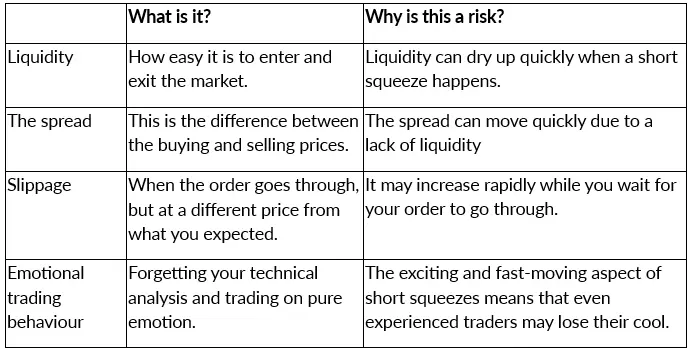
The use of solid risk management principles is necessary when dealing with short squeeze stocks. This means sensible position sizing, stop-loss discipline, and avoiding crowd-driven speculation.
Short Interest and Short Squeeze FAQs for Beginners
What Happens After a Short Squeeze Has Occurred?
This rapid upward movement is often followed by a dump. After the short sellers cover their position, this removes the artificial buying pressure that had been created and may lead to the price crashing back to its original value.
What Are the Signs That a Short Squeeze May Be Ending?
Spotting the peak is extremely difficult, but you should be looking for some clues. The so-called blow-off top is the final vertical move with a huge volume, often followed by a dramatic drop as the volume collapses. The RSI moving downward may also suggest that the asset is now overbought and will fall.
What is the difference between a Short Squeeze and a Gamma Squeeze?
While we’ve looked at the reasons for a short squeeze, a gamma squeeze is a different kind of situation. This is when a large number of call options have been purchased, and the options market market makers are forced to buy the underlying asset to hedge the risk that they now face.
The information provided does not constitute investment research. The material has not been prepared in accordance with the legal requirements designed to promote the independence of investment research and as such is to be considered to be a marketing communication.
All information has been prepared by ActivTrades (“AT”). The information does not contain a record of AT’s prices, or an offer of or solicitation for a transaction in any financial instrument. No representation or warranty is given as to the accuracy or completeness of this information.
Any material provided does not have regard to the specific investment objective and financial situation of any person who may receive it. Past performance is not a reliable indicator of future performance. AT provides an execution-only service. Consequently, any person acting on the information provided does so at their own risk. Forecasts are not guarantees. Rates may change. Political risk is unpredictable. Central bank actions may vary. Platforms’ tools do not guarantee success.